The beginning of most relationships starts smooth. You're both in love, finish each others sentences, and ignore their inability to eat without smacking like a llama; you chalk it up to a personal quirk and keep it moving. Then after six months, their smacking annoys the living Hades out of you (the messed up part is that this person is perfect in every other way). You could be mature and ask your significant other to chew a little softer but no, you want to break up. It's over, there's nothing to talk about (even if you haven't talked about it at all). All that's left is to leave a break-up letter on the refrigerator. The point I'm trying to make is that with any good thing there is some bad. If you like smoking, better beware of lung cancer (unless you're French), if you eat cake for every meal, diabetes is right around the corner, and if you decide to crash a wedding, be prepared to encounter a stage-five clinger. I loved France, but there are 5 things this country needs to work on.
1) Stop saying "Not Possible"
"Not Possible" is the French version of "Epic Fail". When I asked to pass through the Palais before it closed, it was "Not Possible", when I wanted a chicken sandwich at a restaurant it was "Not Possible", when I wanted to see a good movie it was "Not Possible". Whenever I needed something, "Not Possible" was there to deny me. The worse part is that after saying those two dreaded words, the French would twiddle their thin mustaches, laugh, and then take a 2-hour lunch break followed by an hour long cigarette break.
2) Work On The Sidewalks
Watch your step! I'm not clumsy, but in France my equilibrium was off. I didn't have a spectacular fall that stopped traffic, but it was enough to make me question my cat-like dexterity. I take great pride in my ability to stay upright. The curbs are low, and the drivers are crazy. Oh...and the French don't clean after their dogs.
3) Become nicer
Stereotypes are stereotypes for a reason. When 27 Americans congregate outside a residence and talk, we can be a bit on the loud side (loud enough for the French to mock us). However, if Americans are loud, the French are mean. The French do not look at anyone or say hello (or Bonjour) while walking the street. I found the best way to fit in was to scowl a lot, that way your American isn't showing. If you want to make sure you are fitting in, ask these three questions: 1) Do I smile at people on the street? 2) Do I seem approachable? 3) Do I make eye contact with others? If the answer to any of these questions is yes, then your American is showing (start frowning now).
4) Become Greener
The lights in the hallways were on a timer and go off after a certain point. This is a creative approach in the name of being "green", but if no one cleans up after their dogs, it kind of defeats the purpose. In addition to being Michael Myers creepy, the hallway lights cutting off is dangerous (doesn't that violate a fire code or something). It also doesn't help if everyone in France smokes like chimney's (not using plastic grocery bags does not counteract this). No wonder the world was supposed to end in May, during the festival everyone smoked so much that I was convinced a hole was going to be burned into the atmosphere.
5) Gypsies
Last and certainly least, gypsies! Gypsies have replaced Bill O' Reilly and John Cena as my number one mortal enemy. They were like homeless people on steroids; they traumatized us with their begging, threatening, and sand throwing. One girl walked up and begged for my ice cream (we've already established in the last entry that in France I was a big fatty), so of course she didn't get any. That didn't stop her though; she persisted (like a tiny, female Terminator). I walked away and she followed me. They annoyed me a great deal (I needed to get that off my chest).
So, that was my list of the dark side of France (sorry to expose you to that). Everything is not all croissants and beignets. I promise to stay away from top five list for the next update.
Tuesday, June 21, 2011

Monday, June 13, 2011
Review: Tree of Life
Country: USA
Genre: Drama
Director: Terrence Malick
Cast: Brad Pitt, Sean Penn, Jessica Chastin
There are few things in life that are certain: Death, taxes, and Terrence Malick making beautiful movies. His movies are poetry in motion and incredible in scope. Brad Pitt is a sure thing; time after time he's given good if not great performances in movies like Se7en, Fight Club, and The Curious Case of Benjamin Button. Sean Penn may lack a sense of humor, but he always gets the last laugh; he's won two Academy Awards for Best Actor and some will argue he's one of the greatest actors of his generation. Jessica Chastin's career trajectory is pointing upward, and she will be an in-demand actress in the next year if not already. These are guarantess I can go to the bank tomorrow and make good on. So, with all that being said, Tree of Life is a movie that's uncertain about what it wants to be. It loses confidence in the narrative it is trying to present and jumps around from one story to another, not knowing what to do next. The end product is something that's more scattershot than soul stirring.
According to the synopsis I read, Tree of Life was supposed to be about a family learning discovering the meaning behind life after a devastating loss. The movie deals with the meaning behind human existence; that's a lot to deal with in any movie even if your name is Terrence Malick. Grief is the main theme at the films heart; some people take their entire lives learning how to deal with it. However, the movie is more concerned with looking pretty and whispering than it is at discovering anything profound. The long angle lens, deep depth of field, and extraordinary use of lighting make the movie look like art, but the fast cutting and random shots of nature make it something akin to the Discovery Channel. These shots also make the movie seem like a glorified photo shoot. Nevermind that Brad Pitt delivers one of his best performances as the stern father or that Jessica Chastin embodies grace and mercy in an elegant manner as the mother. Nevermind that Sean Penn is wasted in a role that amounts to a cameo as the adult version of the eldest son. Penn walks alot; he walks through his office and through the desert. These actors may get top billing, but they are not the stars: The CGI dinosaurs and kaleidoscope-like cosmic shots are the stars of the movie.
What's frustrating about this movie is that Terrence Malick could have done these themes and these actors justice without losing focus on the family. He could have said something real and relatable because the ingredients are there. The 1950s were a time of conformity in America and the relationship between father and son is dysfunctional; to say the father is overbearing would give overbearing a bad name. The actors are game and the family is a great place to ask questions about existence, death, life, and grace. Just when that aspect of the story is getting interesting Malick delivers a 20-minute montage about the evolution of Earth; from the cosmos to the dinosaurs, Malick leaves nothing out. The movie jumps to present day where a dejected Penn leads a sterile and boring life; then there are more shots of Earth. Malick jumps around like this throughout the movie, like he's impatient. The audience is never given any chance to connect with the characters.
The voiceovers making up most of the spoken words in the movie are whispered prayers to God that the audience has to strain to hear. One of the first whispers asks God why, and according to Malick, God is too busy because the 20-minute documentary film within the film kicks in. Some people may say Malick is telling the story through imagery; ok, then what story can be told through random shots of water, volcanoes, and dinosaurs? Maybe I'm not sophisticated or smart enough to understand, but I swore the story was about the family. Maybe it's commentary on how insignificant human life is compared to the vastness of the universe but then the scenes at the end when Sean Penn is with people from his past does not make sense.
A lot of people will call this a deep, spiritual film. I will argue that this movie is hollow and self important without form. The so-called symbolism does not address the main theme brought up during the first 10 minutes of the movie: Grief. The plot drags for so long it turns into a endurance contest. When the plot gets back to the family, it's not as dramatic or interesting as it could have been. Jack has daddy issues and at one point he whispers to God to kill him; that's powerful stuff. The movie could still be spiritual...and watchable.
I know in time Tree of Life will be seen as a masterpiece from an expectional craftsman. I also know this movie is dishonest; it's a showcase rather than a work of art. It is appropiate that Tree of Life is getting a summer release alongside other blockbusters. Like most summer tentpoles the visuals are cool and there are big names in the cast. Like those movies, Tree of Life is also empty and two hours' worth of it. Score: 5/10
Sunday, June 12, 2011
5 Good Things About France
I would love to say the grass is always greener...but I would be lying: France rocked, and going there during the Cannes Film Festival was better than mayonnaises on fries. The best part was that I didn't have to hear questions like, "What's next graduate?" on a daily basis (one word: plastics). While there wasn't an older woman to seduce me, falling in love with France did not take long. At the risk of sounding unpatriotic, I will list 5 reasons why I loved France (I need to concentrate on something, since I've been back all I do is walk in a daze and cry in the shower).
1. The Food was awesome!
Subsistence goes above all else. I don't eat burgers, condiments, or "French" fries in America (or for the people in red states, Freedom Fries), but in France, I became a total pig. I didn't just eat burgers, and original French Fries; I ate croissants, ice cream, panini's (their like small sandwiches except big), rotisserie chicken, pizza, and other things that should have gave me instant diabetes. I was surprised by the amount of pizza places in France (take that Italy). The food track outside the Palais was my best friend. I went from having a nonchalant attitude towards food to deciding if I was going to wash down my plate of pasta with a chocolate croissant, or another pizza. You would think I'd gain 200 pounds but on the contrary I lost weight, which takes me into point number 2...
2. The Movie diet!
Once I got to France, I wondered why everyone was so skinny (I was home sick; I missed the obesity), but I soon discovered the secret: THEY WALK EVERYWHERE! I walked so much Moses would've said that's a lot of walking. Combine this with getting up early, skipping breakfast, catching a train, dodging security on the train (I didn't buy a ticket, don't tell anyone), getting in line for a movie while the sun is over my head, and walking out of it five minutes after it starts; that's a lot of movement. I also inhaled A LOT of second hand smoke (since beginning this post I've started my sixth pack). The walking, binge eating, and smoking contributed to my weight lose; hence the name. The best part about this diet is that you can do it too! Follow these three simple steps: 1) Walk to your closest movie theatre (I don't care if it's 36 degrees Celsius outside, and 50 kilometers away, Just Do It!). 2) Stand in line, and sweat while eating a panini. 3) Go into the movie, sit for 5 minutes, then leave (your market badge should get you in for free. If not, give them a phony production company card). All of this is contingent on skipping breakfast, and smoking a cigarette before, during, and after every meal.
3) The Beauty!
The beauty in France increased 100 fold during the festival. Of course there were celebrities (my new crush/obsession is Emily Browning). I'm talking about the "other people", and by other people I mean the models who turned Cannes streets into runaways during the night time premieres. The scenery was beautiful as well; I only spit my gum out in trash cans out of fear I would ruin something (trash cans were far and in between so flavorless gum was a common occurrence). The beach was breathtaking (not because old ladies went topless, that's the bad breathtaking); the water was so clear, and blue. Everything had grace, and elegance to it; even the birds.
4) Cheap liquor!
I don't drink, but I can appreciate cheap booze as much as the next man. Alcohol can be bought just about anywhere; the grocery stores sold wine for 3 Euro (or about 6 American dollars). Beer was about 6; and they didn't check IDs. There's nothing like going to the beach with friends, watching them get drunk, getting harassed my demon children (their proper names are gypsies), and witnessing one of your classmates yell in French that she will call 112 (their bizarro world version of 911). Good times, good times...
5) No News!
It's not that there wasn't news in France, it's just that where I stayed the internet was spotty, and the T.V only picked up one English channel (ironically, it was CNN). I could only check my e-mail in the American Pavilion, but even that was a challenge. It felt great to not hear what was going on in America every second of the day; I even lost track of the NBA playoffs (old habits die hard).
These are the 5 reasons I am ready to renounce my citizenship; it's that serious. I guess being back in America isn't that bad, there are nice things here. Now if you will excuse me, I need to finish my crepe, and afternoon cigarette.
Monday, June 6, 2011
Review: Sleeping Beauty
Country: Australia
Genre: Drama
Director: Julia Leigh
Cast: Chris Haywood, Emily Browning, Ewan Leslie, Peter Carroll, Rachael Blake
Once upon a time in a far away land there was a princess name Lucy (Emily Browning). Lucy was the most beautiful princess in all the land; she had skin white as snow and lips red as rubies. She was petite with long, curly hair with brown eyes, and a face as round as the moon. Lucy was not like other princesses; she did not mind being around peasants. She took magic pills that made her very happy and sniffed white pixie dust through a straw. She knew several princes and entertained a different one every night. Lucy was an independent princess; she worked several jobs in order to stay in her castle but these jobs were not enough. One day, Lucy is offered a job by a woman named Clara (Rachael Blake). Clara tells Lucy all she has to do is sleep; the job pays a lot of money and Lucy can buy as much pixie dust as she wants. Lucy says yes to Clara and becomes a Sleeping Beauty for old, wrinkled up kings looking for a happy ending.
The author (i.e, director Julia Leigh) writes about Lucy a lot but does not give a clear idea of who she is or the reason behind her actions. Julia Leigh makes the reader strain for any details about Lucy; she is far from the fairest of them all but without reason Lucy seems too much like a doll than a person. The author keeps the reader at a distance; hindering the story's ability to develop an emotional connection. This measured and cold approach keeps the emotional moments from working because Leigh keeps pushing the reader away and away to the point of apathy. It's like cranking up a car when the gas tank is empty. Though she's not lazy, she's also not working hard enough to keep interest up. Each chapter (i.e, scene) is calculated but the language is too robotic.
The words (cinematography) is beautiful, yet cold; the reader is not given any more than what is believed to be needed and even that is not enough. It can be frustrating when the reader looks for context under the surface and there is nothing to work with. It's not surprising if the reader does not care about Princess Lucy.
Princess Lucy is beautiful to look at and this erotic world she inhabits is dangerous and interesting, but not sexual or graphic. Princess Lucy is pure in appearance, from here porcelain like skin to her doll like face; Princess Lucy is an enigma in a story about her. She does not change in anyway nor is her character explored. When she wants to find out what happens while she's asleep it comes with no warning. Though the reader knows some of what's happening, it's still murky because Leigh brings each chapter with the old men to a abrupt end. For most of the story Princess Lucy lives her life without much conflict or if there is it's below the surface. The only person Princess Lucy seems to care about is a peasant name Birdmann (Ewen Leslie) but like everything else in the story, readers have to rack their brains to the point of exhaustion in order to find out why.
Julia Leigh does not give readers anything to work with in terms of storyline, making the book feel weightless. There are so many questions about why, when, where and how that Sherlock Holmes may be the only person who will find this book enjoyable. The plot unfolds out of chronological order and the minimalist style of storytelling leads to a lot of dead ends. This fairytale is in no hurry and takes its time. While there are a lot of questions involving the characters and many readers will talk amongst themselves as to what the moral of this tale is, I question whether this fairytale says anything at all. The premise is interesting but most of the book does not even deal with Princess Lucy's sleeping spells. The experiences do not matter until the very last chapter. I do not know if this fairytale has a voice or story worth telling. What's the use of following Princess Lucy around if there is no connection to her? No one wants to be spoon fed or treated like an idiot but there has to be something there.
Julia Leigh dares readers to feel nothing, like it's an exercise in restraint. It's a shame because it could have been beautiful, it's so unique. The questions surrounding the story takes away from the fairytale; from the experience. Because the story does not come into play until the last ten pages, the lack of any conflict, personality or commentary is maddening. There has to be some reason this book was written; some reason for it's existence. It's not drama filled, or action packed, plot driven or sexually exploitive; the story does not try to be anything. Everything is under the surface and never rises; it does not even simmer. Whatever the mystery is, it's not worth the effort.
After the final chapter is read and the book is closed, Sleeping Beauty is a fairytale without a happy ending; there's not an actual ending. The story never begins and floats around like morning dew above grass. Princess Lucy stays beautiful but never becomes interesting. There is no emotion, no lingering feelings, just nothing, like the book was never read. Score: 5/10
Review: When I Kill Myself
Country: Japan
Genre: Drama
Director: Ryo Nakajima
Cast: Keisuke Koide, Erena Mizusawa
With a title like this there's zero ambiguity. It's an eye catcher; what you see is what you get. When I Kill Myself is about suicide but it should not be passed over because of its subject matter. It's rare that a movie can be about suicide and still inspire thoughts about our lives outside the movie theatre. Good movies are supposed to make the audience question the meaning of their own existence; this is one of those movies. The question at the heart of the film is: What keeps us from dying? Death does not have to be physical; it can be spiritual, financial, or relational. Before people in this movie kill themselves in the physical sense something else dies first: Hope.
When I Kill Myself takes place in Japan's near future. Teenagers are killing themselves at an alarming rate and in order to get ahead of this epidemic the government institutes a program that selects 10-year-olds all over Japan at random. These chosen children are taken from their parents by force, and implanted with heart stopping devices. The children are given heart stopping buttons that allow them to kill themselves. Most lose hope and succumb to death. After seven years, suicides in Japan plummet "thanks" to the research. The government wants to pull the plug on the project but there's a problem: Six teenagers are still alive. The government officials, and prison staff wonder why these six refuse to die.
This movies biggest strength is its bravery; it has no fear. It's not afraid to force the characters to make hard choices nor is it afraid to make its characters look unsympathetic. All the characters from the six teenagers to the government official heading the program have clear goals. The government official wants this to go away like any politician would. The guards in the facility have had to do terrible things and watch children kill themselves for seven years. This would be enough to twist the best person; this does not excuse their actions but at least the motivation is understood. The teenagers depend on a combination of each other and wanting to see their families again.
These reasons to stay alive become weights around their necks throughout the movie. Every character faces disappointment; some turn on each other, and others are confronted with reality. For example; Yohei, (Keisuke Koide), a kind guard no older then the teenagers in the facility, gives Ryota, (Taiga), the most child-like person in the group, letters from her parents. She reads the letters and is happy until a recent letter informs her about another child. I am the oldest of three; I have two younger sisters. When our parents brought home our baby sister I didn't mind as much, but my younger sister told our parents they could take her back to the hospital. The feeling of fighting for parents affection, and feeling unwanted is something most siblings can relate to. Another example of emotion applicable to real life is jealously; this happens when Yohei becomes close to Masami, (Elena Mizusawa), the other girl and leader of the group. This makes Naoto, (Kazuma Sano), jealous; he's in love with her, and their bond is very close. I won't give away how close their bond is, but it alters the course of the film.
The strong character development counteracts the look of the film. While its not terrible, it can be somewhat distracting. The movie is shot on HD and it shows; the color of the facility is gray but the lighting and digital camera makes it look more grayish-green. When other parts of the facility (or prison) are seen the gray comes out more. This may not be an issue for most people who could care less about the difference between film and digital but it's something that distracted me. The scenes shot outside of the facility have great lighting and are beautiful to look at.
Another issue with the film is that the plot uses unnecessary flashbacks to explain the back story. These flashbacks act more like exposition and repetition; it's already clear how, and why the characters act the way they do. The characters who need more back story (ex: Masumi) do not get it. It's a hard balance to strike but the film comes so close to doing; it's hard to imagine why it does not get there. These frequent flashbacks also come at key points in the movie and disrupt the pacing of the narrative. I may be nitpicking but this movie offers so much and does so many things right, but it's the little mistakes that keep it from becoming something special, potential untapped is what keeps good movies from becoming great movies.
When I Kill Myself is a movie that will stay with anyone long after the credits roll and the lights come on. It's a deep movie that explores the human condition in a way imitators (cough...Tree of Life...cough) try, and fool people into believing they are. There are not too many movies nowadays that have the power to move and affect the audience. When one is made, it is the responsibility of the audience to tell others, have debates, and watch the movie again for anything we may have missed the first time. Movies, and music are two mediums that can evoke this type of emotion and When I Kill Myself succeeds in creating emotion, not exploiting it. Score: 8/10
Thursday, May 26, 2011
I Need To Talk About Tilda

On Day 3 of the Cannes experience we saw We Need To Talk About Kevin, Tilda Swinton's new movie. It was an great film (I won't go into too much detail about it; I will write a review for it). She was amazing in it, but that's like saying water is liquid. Tilda Swinton delivers great performances time, and time again. From Michael Clayton (She won a Academy Award for Best Supporting Actress) to Burn After Reading, she's always captivating, and natural. It's like she's not trying; it's just who she is. She has a tendency to play ice queens (she played a literal ice queen in the Narnia films). Judging from her roles, and how convincing she is in them; I thought she was a thespian who took her craft as serious as a heart attack. I was dead wrong.
When Tilda talked with our class, she couldn't have been more different from the characters she's portrayed. She smiled, laughed, and told funny stores. She's so down to Earth without a trace of ego. I couldn't believe it; Tilda Swinton was like us (except she's a critically acclaimed actress with an Oscar; I'm a struggling screenwriter who's never won any type of contest. I'm also a guy and not Scottish).
Three things she talked about stood out to me:
1. When thinking about signing onto projects she doesn't look at the script, she looks at the people. She believes movies should be a collaboration with all the people involved. The most important thing to her is trust; she works with people she has a history with. There are some exceptions (Like Tony Gilroy, writer/director Michael Clayton), but genuine people are first, and foremost.
2. She talked about how her children inspired her. She told a story about her son seeing Vertigo for the first time (its a Alfred Hitchcock film). He liked the movie, and wanted to see more of his films because the direction was superb (he was ten; at ten I thought Batman and Robin was a good movie).
3. The final thing I took from her talk was the answer to a question posed by yours truly. I was curious about how she improved as an actress over the years. I like to hear about the creative process people go through in preparation for a major work. I asked this question:
"How have you grown as an actress?"
I had to repeat the question because she didn't hear me; she thought about for a moment, then answered:
"I don't know. I don't think I've grown as an actress."
I felt like I asked a stupid question, but she elaborated:
"I'm not an actor. Sometimes I feel actors get caught acting. I'm a performer...I can't say I have really grown as an actress."
Then it hit me. I thought about everything she said. Never she referred to herself as an actress. I believe what she meant was that some actors make movies in order to show how good they can act. Its not always Oscar bait movies, but they're showy roles. Some actors are caught acting for acting sakes.
Performing implies that a level of professionalism goes into making a film. I thought about it like this; we don't act in front of our family; they're the only ones who see all three dimensions for better, or for worse. She only collaborates with people she knows so it's not acting; it's a role to be played. She seems to look at it like a job; not a hobby, or a vehicle to fame. Its freeing to think of it in that regard.
Well, that's enough psycho babble. I'm not her spokesman; I'm just an young man trying to understand. Most people can come to their own conclusions about what she meant; that's just how I interpreted. Her approach may not work for everyone, but it works for her. One thing was for certain; she wasn't performing in front of us that Saturday afternoon. It's impossible to fake elegance, and intelligence; no matter how good of an "actor" someone is.
Cannes Begins

Prologue
The day before Cannes felt like a training montage: we checked in at the Palais, and got our badges. The Palais was where all the big events happened; screenings, press conferences, Lars Von Trier, everything. Behind the Palais was the Riviera; in addition to holding screening, this was where distribution companies set up shop, and tricked companies into buying their movies (did I say tricked? I meant sold). Behind the Riviera were Pavilions; each country at the festival had one (guess which Pavilion we hung out in). Along the main strip were hotels like the Majestic, the Gray, the Carlton, the Donte' (sorry, speaking into my future).
Our market badges allowed us into these hollowed halls, and if we sat long enough (or were drunk enough, same difference) a celebrity would come out of hiding, and ignore us. Our teachers told us to protect the market badges with our lives if necessary (I slept with mine under the pillow...no, seriously). After hanging around Cannes, I went back to JLP (Juan Les-Pines is the proper name, but college students abbreviate everything). I looked at all the movies scheduled for In Competition, Un Certain Regard, and market screenings. I looked over the train schedule, and packed the tux. Before falling asleep I took out my totem, and spun it. It toppled over, I wasn't dreaming.
Our market badges allowed us into these hollowed halls, and if we sat long enough (or were drunk enough, same difference) a celebrity would come out of hiding, and ignore us. Our teachers told us to protect the market badges with our lives if necessary (I slept with mine under the pillow...no, seriously). After hanging around Cannes, I went back to JLP (Juan Les-Pines is the proper name, but college students abbreviate everything). I looked at all the movies scheduled for In Competition, Un Certain Regard, and market screenings. I looked over the train schedule, and packed the tux. Before falling asleep I took out my totem, and spun it. It toppled over, I wasn't dreaming.
Cannes: Day One
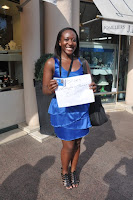

I got to Cannes around 11:00 am (or 5:00 am AT), and went into the Palais. I checked my tux, and saw my first movie upstairs. It was called Turn Me On G*d***it (got to keep it PG). It's a Norwedgian film about a horny teenage girl coming to turns with her sexuality, and over active imagination. About 9 of us saw it (the lady scanning badges looked us strange because we all gave her Peachy Dawg Production cards; like she's never seen 9 buyers from the same company). The movie was good despite it's title; it was like Judd Apatow, and Diablo Cody wrote a screenplay together. It was funny, touching, and featured a lot of nudity (which would become an ongoing theme throughout the festival). The next movie I saw was called Unwelcome. Should've known the title was a warning; it was horrible, and that's the nicest thing I can say about it. This movie also had a lot of sex (I think there's a quota of T&A each movie has to meet to be screened). I tried to see Attack The Block, but thanks to Murphy it was a no-go. Didn't have time to dwell on that, I had to get ready for the 19:15 (7:15 pm AT) premiere of Midnight in Paris; the new Woody Allen movie opening the festival. It was tuxedo time!
It wasn't as exciting as the exclamation point suggests. I just wanted to get in for the experience; it wasn't fun. I got dressed in a bathroom stall so small even Superman would've had trouble changing, and he had a phone booth. After changing, I made a sign to beg for tickets (I failed to mention that changing into a tuxedo in a smelly bathroom was no guarantee I would see the movie. Murphy-2, Donte'-0).
I stood outside in my tux sweating, and begging (I was the best looking hobo France had ever seen). On top of that, my bow tie was falling apart, and I kept adjusting it. By 7, it tore apart. I picked it up (and my pride), and went back to Juan defeated, and a little smelly (Murphy was winning). As a consolation prize my photo was taken (so when I become famous this photo will resurface just to spite me). I got back to the room, poured some orange juice (still in my tux), and slipped it slow (my dream since that morning). I knew things would get better (it wasn't like I could go home). I pulled out my totem, and spun it; it kept spinning. I was getting worried, but it wobbled a little. Then--
Subscribe to:
Posts (Atom)